
The Durability Stack
Policy risk isn’t binary

Back in June I wrote about treating regulatory engagement as a governance practice, and showing up while the rules are still being written.
This is an unintentional part 2, spurred by Bruce Mehlman’s Age of Disruption and one question in it: how can businesses plan and invest for the long term when the rules keep flip-flopping?
Part 1 was about showing up to the process. This one is about designing so you depend less on how it turns out.
Three weeks ago a deadline passed that the US solar and wind industry had spent two years running toward. Projects that began construction by July 4, 2026 keep the clean electricity credits under Sections 45Y and 48E. Miss it and you have to reach service by the end of 2027 or lose them.
Simple enough, except the definition of “began construction” moved four times while everyone was running.
The Inflation Reduction Act created 45Y and 48E in August 2022 with a runway into the 2030s. The One Big Beautiful Bill Act cut that runway on July 4, 2025 and set the 2026 deadline. Three days later Executive Order 14315 told Treasury to tighten what counted as beginning construction, and by August 15 the IRS had done it: Notice 2025-42 killed the 5% safe harbor for all wind and for solar above 1.5 MW. Then on June 6, four weeks out, a federal district court vacated that notice and sent it back. The appeal is pending. The deadline came and went with the rule still unsettled.
This was the tax code. The part of federal policy everyone treats as bedrock.
Altitude Isn’t Durability
Executive orders are fragile, regulations sturdier, appropriations sturdier still, and anything in the tax code is close to permanent. Call that ranking altitude. The assumption underneath it is that altitude buys durability.
45Y is the proof it doesn’t.
The statute was never the binding constraint. Congress wrote “beginning of construction” into law and left Treasury to define it. That definition decided whether tens of billions in projects qualified, and it arrived as an agency notice, written at the direction of an executive order, before a district judge threw it out. Altitude told you nothing. What mattered was that the statute handed the deciding phrase to somebody else.
Count the Hands Between the Rule and the Cash
Every party who can reinterpret a rule is a point of failure. The number of them is the risk.
So count the parties who can change the answer between the written rule and money hitting your account. A signed offtake with a creditworthy counterparty is one party, and they owe you damages if they walk. A tax credit with a statutory formula and no discretionary term is two, Congress and the IRS. Put the deciding phrase in guidance instead and you’re at four, one of whom is a judge. A competitive grant that’s been announced but not funded is one party who owes you nothing at all.
Two of those lines have a count of one. What separates them is whether anybody owes you money when they change their mind. In United States v. Winstar, the Supreme Court held that the government keeps its sovereign power to change the law and gives up the ability to change it for free. Break a government contract with a policy reversal and the government pays. A signature turns the whiplash into somebody else’s liability.
A Commitment Isn’t a Contract
Knowing which one you’re holding is harder than it should be, because the vocabulary blurs it. Selection, award, conditional commitment, financial close. Same letterhead, same press release, and only one of them binds the government.
A conditional commitment is DOE saying it intends to lend once you clear the conditions precedent. Financial close is the executed loan agreement. Everything before close is intent with homework attached.
DOE spent January demonstrating the difference. It announced it was canceling $30 billion in loan obligations from the prior administration and revising another $53.6 billion. Closed loans got honored. Conditional commitments didn’t. That distinction is the whole difference between recourse and a press release.
Grants sit in between, and it’s less comfortable there than it looks. A grant agreement obligates the money and still leaves the agency termination rights, which turns a reversal into litigation rather than a damages claim. EPA terminated the $20 billion Greenhouse Gas Reduction Fund in March 2025. Sixteen months later it’s still in the D.C. Circuit with no final decision.
Run the Same Test on States
The reflex when federal policy gets unstable is to go local. Run the count one level of government down first.
Altitude works the same inside a state, with statute on top and agency regulation below it. What changes is who can reach the top. A state legislature is smaller than Congress, often unified under one party, and can move in a single session.
Virginia joined the Regional Greenhouse Gas Initiative by regulation, a later governor pulled it back out by regulation, and the churn only stopped when the legislature put it back by statute in February. Pennsylvania ran the same lever the other way: in by regulation, out by statute last November. If a state compliance market sits in your revenue model, find out which instrument put that state in. A governor can move against a regulation without the legislature, and unwinding it afterward took Virginia years.
California shows the upside. Last September it extended cap-and-trade through 2045 by statute, which gives anyone selling into that compliance market a twenty-year horizon to underwrite against. No federal climate program offers that today.
Connecticut is the counterexample. Its green bank has mobilized $3.11 billion of clean energy investment since 2011, drawing roughly $2.65 billion of private capital in behind $463 million of public funds. However, in 2017 the legislature still swept roughly $175 million out of the funds it runs on. The bank’s authority sits in statute. Its money sits in ratepayer charges that run through the state budget every year. Check the altitude of the cash, not the institution.
Fewer parties doesn’t mean less risk.
What to Price
Start with the instruments. Pull every line of revenue and capital you’re counting on and name what each one is: an executed contract, a conditional commitment, a grant agreement, a credit whose definition lives in guidance. Then count the parties on each, and check where the money sits rather than where the program sits. The lines with high counts and no damages are the ones your investors will find in diligence, and it’s better if you find them first.
Investors have the harder problem. Climate diligence still treats policy as a binary input, where the credit is either in the model or it isn’t. That’s a 2019 habit running in a 2026 risk environment.
Infrastructure finance already prices uncertainty when it wants to. Merchant exposure carries a premium everyone applies without argument. There’s no equivalent for reversal risk, no accepted haircut for revenue that depends on a definition an agency can rewrite by memo, and I don’t have one to hand you. So it gets priced at zero, right until it gets priced at a hundred.
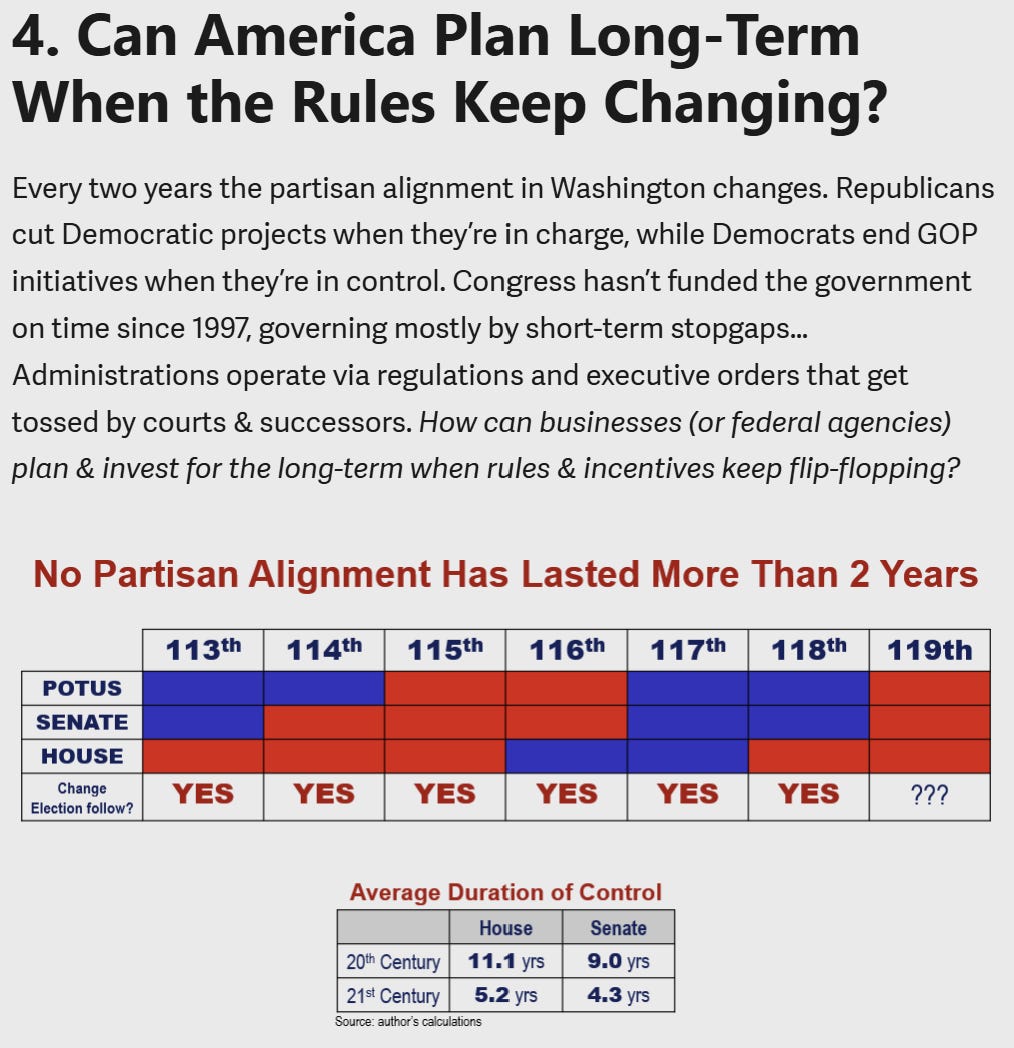
Six consecutive elections have flipped control of the House, the Senate or the White House, a streak Bruce Mehlman puts at a modern record. Nothing in that pattern is about to break, so durability has to come from your side of the table.
The companies that stay financeable through the next reversal will be the ones that can hand a lender a single page showing which revenue lines somebody can take away with a memo, and what that would cost. Most of your competitors can’t produce that page.